 Reviews

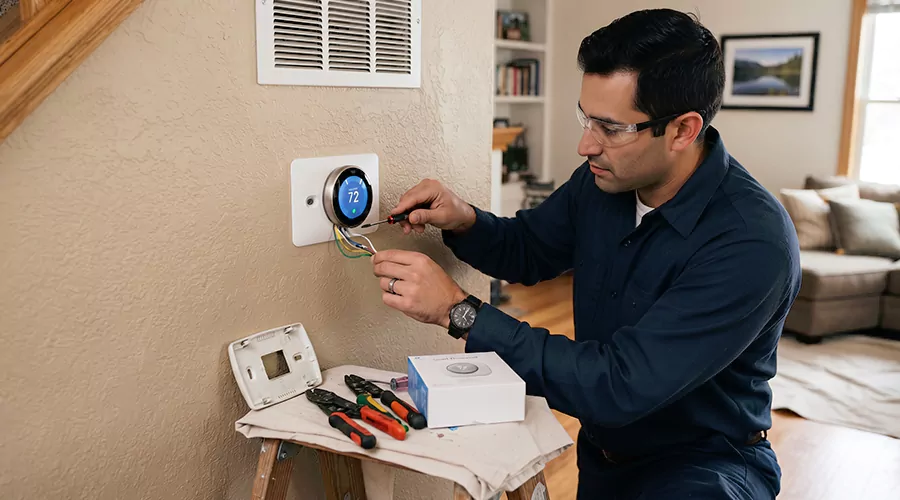
HVAC thermostat replacement typically costs about $114 to $264 with professional installation in 2026. Simple replacements can fall near $68. More complex smart thermostat projects can reach $500 or more when new wiring is required.
The thermostat itself is only part of the bill. Wiring compatibility can raise the total. A missing common wire can also add labor.
A thermostat problem does not always mean the wall control needs replacement. Dead batteries or loss of HVAC power can create many of the same symptoms.
What Does Thermostat Replacement Cost in 2026?
A standard professionally installed thermostat usually costs about $114 to $264 in 2026. Basic replacements can cost less. Smart controls or complicated wiring can push the total toward $500 or more.
Replacement Type Planning Table
| Replacement type | Typical 2026 cost |
|---|---|
| Basic thermostat replacement | $100 to $200 |
| Standard professional replacement | $114 to $264 |
| Programmable thermostat | $120 to $300 |
| Smart thermostat installed | $150 to $450 |
| Added C-wire | $90 to $135 |
| Complex wiring project | $300 to $500+ |
Professional labor commonly runs about $65 to $100 per hour. The HVAC thermostat replacement price rises when installation takes longer than a simple like-for-like swap. One home may already have compatible wiring, while another may need a new wire run through a finished wall.
What Makes Thermostat Replacement More Expensive?
Thermostat type has a large effect on replacement cost. Existing wiring matters almost as much. A basic control can connect to an existing low-voltage system quickly. A smart thermostat may require constant power. Heat pumps or multi-stage equipment can also need more careful configuration.
Thermostat Type
Basic digital controls are usually the least expensive, while programmable thermostats cost more because they add scheduling. Smart models normally cost more again, and the price difference becomes larger when professional setup is included.
Wiring
Existing wiring can make the installation simple, while older homes may lack the wire required by some modern controls. New C-wire installation commonly costs about $90 to $135, although longer wire runs can cost more. Wall access can also increase labor.
HVAC System Complexity
A simple single-stage furnace and AC system can use a relatively basic thermostat, while heat pumps can require additional terminals. Dual-fuel equipment can need more complex control logic, and variable-speed equipment or zoned systems may also require specialized controls. Compatibility should be checked before buying the thermostat. The most expensive thermostat on the shelf is not automatically compatible with the most expensive HVAC system.
How Much Does a Smart Thermostat Cost to Replace?
A professionally installed smart thermostat often costs about $150 to $450 in 2026. The price includes the control plus normal labor under straightforward conditions. A missing power wire can increase the total. Advanced HVAC systems can also require proprietary controls instead of a common retail smart thermostat.
The thermostat hardware can represent a large part of the price, while professional installation adds labor and configuration can take additional time. Wi-Fi setup itself is rarely the largest cost issue; electrical compatibility usually matters more. A smart thermostat should not be selected based only on the shape of the old wall plate. The terminal configuration matters, and the HVAC equipment type matters too.
How Much Does a C-Wire Add to the Cost?
Adding a C-wire commonly costs about $90 to $135 in 2026 under straightforward installation conditions. The total can rise when the wire must travel through difficult finished areas. Some systems can use an approved adapter instead. Compatibility should be confirmed before deciding which approach is appropriate.
The C-wire provides continuous low-voltage power, and many smart controls need that power for their display and wireless functions. Some older thermostats operated without one, but that does not mean the HVAC system itself is incompatible with modern controls. It means the installation may require another power solution. Do not assume unused wires behind the thermostat are connected correctly at the HVAC equipment. The other end needs verification too.
What Are the Signs You May Need Thermostat Replacement?
A failing thermostat can create incorrect temperature readings or an unresponsive display. It can also stop the HVAC system from responding normally. Short cycling is another possible warning sign. These symptoms can have other causes, so basic troubleshooting should happen before replacement.
10 Warning Signs of Thermostat Failure
- The thermostat screen remains blank after new batteries.
- The displayed temperature is clearly inaccurate.
- The HVAC system does not respond to setting changes.
- Heating starts when cooling is requested.
- Cooling does not stop at the selected temperature.
- The system starts and stops unusually often.
- The thermostat loses programmed settings.
- Buttons or touchscreen controls stop responding.
- Temperature control becomes inconsistent.
- Problems continue after the thermostat has been reset.
A bad thermostat can look like an expensive HVAC failure. That makes the wall control worth checking early in a no-heating or no-cooling diagnosis.
How Does a Thermostat Problem Progress?
Thermostat problems often begin with an intermittent display or inaccurate reading. Simple power problems can cost almost nothing to correct. Wiring issues increase the repair price. Full replacement usually stays in the low hundreds unless the project requires new wiring or advanced controls.
Thermostat Problem Progression Table
| Stage | What you notice | Possible cause | Typical 2026 cost |
|---|---|---|---|
| Early | Screen goes blank | Dead batteries | Low DIY cost |
| Power issue | Display remains dead | HVAC power problem | Diagnosis needed |
| Reading problem | Temperature seems wrong | Placement or sensor issue | $0 to $300 |
| Control issue | HVAC responds inconsistently | Wiring or thermostat | $114 to $319 |
| Replacement | Control has failed | New thermostat | $114 to $264 |
| Wiring upgrade | Smart thermostat lacks power | New C-wire | $90 to $135 extra |
| Complex upgrade | Advanced system needs special control | Premium installation | $300 to $500+ |
The overlap between repair and replacement cost explains why repair is not always cheaper. A modest replacement can cost about the same as paying for diagnosis plus an older thermostat repair.
Can a Bad Thermostat Make the AC Stop Working?
Yes. A thermostat sends the cooling request to the HVAC equipment. A failed control or bad wiring can prevent that command from reaching the system. The same symptom can also come from the air conditioner itself, so thermostat testing should happen before assuming the wall control has failed. An AC thermostat replacement should therefore follow diagnosis.
Start with the display. Check whether cooling mode is selected. Lower the target temperature and wait several minutes for the normal compressor delay. Listen for equipment response. A thermostat that clearly changes modes but receives no response has narrowed the problem, but it has not proved that the thermostat is defective. The fault could exist elsewhere in the control circuit.
Can a Bad Thermostat Stop a Furnace From Heating?
Yes. A furnace relies on the thermostat to request heat. A failed thermostat can prevent startup even when the furnace itself is operational. Dead batteries or faulty wiring can create the same symptom. Furnace troubleshooting should therefore begin with basic thermostat checks before internal heating components are blamed. A furnace thermostat replacement can make sense when the control itself has been confirmed faulty, but do not replace it simply because the burners fail to start.
Check the operating mode first. Raise the target temperature several degrees and wait for the startup sequence. Confirm that the thermostat remains powered. A heating failure can still come from the furnace because the thermostat is only one link in that process.
What Safe DIY Test Can You Perform?
A five-minute thermostat test can identify simple problems without opening HVAC equipment. Check the display first. Replace batteries when applicable. Set the correct operating mode. Create a clear temperature request. Then wait for the system to respond before deciding that the thermostat has failed.
DIY Testing Steps
- Look at the thermostat display.
- Replace batteries if the model uses them.
- Select Heat or Cool.
- Create about a 5°F temperature difference.
- Wait five minutes.
- Listen for the HVAC system.
- Compare the thermostat reading with a separate thermometer.
- Check whether controls respond normally.
Poor thermostat placement can create inaccurate readings. Direct sunlight can affect the sensor, and a nearby supply register can also distort the temperature.
Do not begin moving wires around if you do not understand the terminal layout. Turn off HVAC power before thermostat wiring work, and take a photo of the existing wire connections before removing anything. That simple step can prevent confusion later.
Can You Replace a Thermostat Yourself?
Some basic low-voltage thermostats can be replaced by a careful homeowner. The project becomes less suitable for DIY work when wiring is unclear or the system uses advanced controls. Heat pumps can require additional configuration. High-voltage thermostats require greater caution.
- Start by checking compatibility.
- Turn HVAC power off before disconnecting wires.
- Label every wire by terminal.
- Do not rely only on wire color.
- Wire colors are common conventions rather than guaranteed terminal assignments.
Older homes create another concern. A thermostat may contain mercury if it is an older mechanical model. Do not break the glass bulb inside such a control. Follow local disposal requirements instead.
When Should You Call a Professional?
Professional help is appropriate when the thermostat stays blank after simple power checks. It is also appropriate when wiring is damaged or the HVAC system behaves unpredictably after thermostat commands. Advanced heat pumps or zoned systems can need specialized configuration that goes beyond a basic wall-control swap.
Call when the breaker has tripped. Do not repeatedly reset an HVAC breaker without diagnosing the problem that caused it. Professional diagnosis also makes sense when the thermostat displays the wrong temperature after placement issues have been ruled out. A technician can verify the control voltage, check the wiring for continuity, and test equipment response from the thermostat circuit.
This prevents replacing a working thermostat when the actual failure is at the furnace or air handler. The diagnostic process matters most when the HVAC system is completely dead. One inexpensive control should not be blamed for every no-start symptom.
When Should You Replace Instead of Repairing the Thermostat?
Replacement often makes more sense when an older thermostat has an internal electronic failure. It can also make sense when repair cost approaches the price of a new unit. Many thermostats can last around 10 years, but actual life depends on the control and operating conditions. A simple battery issue should be repaired, and a loose connection can also be corrected. A damaged display creates a stronger replacement case. Repeated loss of settings can indicate an aging control, while an inaccurate internal temperature sensor is another reason to compare replacement.
The cost difference is often modest. Thermostat repair commonly overlaps with the cost of installing a new basic control. That can make replacement more practical when the existing thermostat is already old.
How Can You Prevent Thermostat Problems?
Thermostat reliability improves when the control has stable power and correct placement. Replace batteries before they completely deplete, keep the thermostat away from direct sunlight, and avoid blocking it with furniture. Watch for unusual HVAC cycling because control problems can appear before a complete failure.
Do not paint over the thermostat. Avoid placing heat-producing electronics directly beneath it, and keep supply air from blowing directly onto the sensor. Replace batteries on a regular schedule when the control requires them. Check smart thermostat software when unusual behavior begins.
Keep the original wiring photo after installation. The photograph can help during future troubleshooting. Compatibility records are useful too. Save the thermostat model with your HVAC equipment information. That makes future replacement easier.
Conclusion
HVAC thermostat replacement generally costs about $114 to $264 in 2026. Smart controls or new wiring can raise the price toward $500. Check batteries and system power before buying a replacement. Confirm compatibility before installing a new control. A professional diagnosis is useful when the entire HVAC system remains unresponsive. This week, compare your thermostat reading with a separate room thermometer.
Frequently Asked Questions
A straightforward replacement can often take less than one hour. New wiring or advanced system configuration can extend the installation time.
Many thermostats can operate for about 10 years. Actual life depends on the device and operating conditions.
Not every model requires the same power method. Many smart controls need continuous power through a C-wire or approved adapter. Check compatibility before installation.
It can when a faulty thermostat is causing the cycling. Short cycling can also come from other HVAC problems. Diagnosis should confirm the cause before replacement.
Most standard low-voltage replacements can be handled by an HVAC technician. More complex electrical work can require an electrician depending on the system and local requirements.
Small fixes can be worthwhile. Replacement becomes more attractive when repair approaches the price of a new control or when an older thermostat continues to fail.